
How to build your own workout program
There is a strange power in building your own program. A plan you designed around your goals, your schedule, and your body is one you understand and, crucially, one you will actually follow. Downloaded programs from a magazine or an influencer are built for an average person who is not you. They ignore how many days you can train, which exercises your joints tolerate, and what you are actually trying to achieve. Learn to build your own and you gain a skill that outlasts any single plan.
The good news is that program design is not a dark art. It is a sequence of five decisions, made in order, each one narrowing the next. This guide walks you through all five: setting a clear goal, choosing your training days, picking a split, selecting your exercises, and assigning sets, reps, and volume. At the end you get a fill-in template you can complete in ten minutes. If you want the theory behind the reps and sets first, our sets and reps guide is a good companion, and the muscle building guide gives the wider context.
Step 1: Define one clear goal
Every program starts with a single honest question: what do you actually want? The three most common answers are building muscle, gaining strength, and losing fat while keeping muscle. These are not the same, and trying to chase all three at once usually means progress in none. Pick the one that matters most for the next three months and let it steer every other decision.
Your goal sets the tone for rep ranges and exercise choice. Muscle building favours moderate reps and a mix of compound and isolation work. Strength leans on heavy compounds and lower reps. Fat loss keeps the lifting heavy to protect muscle while a calorie deficit does the fat work, and our fat loss programs show how that looks in practice. Write your goal at the top of the page before you do anything else.
Step 2: Count your realistic training days
The second decision is the most honest one: how many days a week can you train, reliably, on a normal week rather than a perfect one? Three days is plenty for a beginner. Four suits most working adults. Five or six is for those who can genuinely protect the time and recover from the load. Our how many days per week article helps you decide.
Be conservative here. A program built for four days that you complete every week will always beat a six-day plan you abandon. The number you choose directly determines your split in the next step, so pick a number you can defend even when work and life get in the way.
Step 3: Choose the split that fits those days
Now match a split to your day count. This is a solved problem, and forcing a mismatch is one of the most common design errors. The mapping below keeps frequency high without asking for days you do not have. For a deeper walkthrough, see our guide on how to choose a workout split.
| Days | Split | Frequency per muscle |
|---|---|---|
| 3 | Full body | Roughly 3x per week |
| 4 | Upper/Lower | 2x per week |
| 5 | Upper/Lower + specialty | 2x plus a focus day |
| 6 | Push/Pull/Legs x2 | 2x per week |
Notice that all of these hit each muscle at least twice a week, which is the frequency most evidence favours for growth. Whatever split you choose, aim to keep that twice-weekly minimum. It is the single structural feature that separates a good self-made program from a random one.
Step 4: Select your exercises
With a split in place, fill each day with exercises. The reliable formula is to anchor every session with one or two big compound lifts, then round it out with isolation work for the details. Compounds like the barbell full squat, the bench press, and the deadlift train the most muscle for the least time, so they earn the first slots. Isolation moves such as curls, lateral raises, and calf raises then polish the smaller muscles.
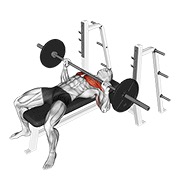

A practical guideline is four to six exercises per session: two compounds and two to four isolations. Cover every major region across the week: chest, back, shoulders, arms, and legs. Choose movements your joints tolerate and that you can perform with good form, since a lift you cannot do cleanly is not building anything. When in doubt, prioritise form over ego, a principle our form before weight article expands on.
Step 5: Assign sets, reps, and weekly volume
The final step turns your exercise list into a working plan by attaching numbers. For most goals, three to four sets per exercise in the six to twelve rep range is a dependable default. Compounds can sit at the lower reps for strength, isolations at the higher end for detail. The larger target to watch is weekly volume: roughly ten to twenty hard sets per muscle group per week, a range our weekly training volume guide breaks down.
Numbers on paper mean nothing without progression. The engine of every good program is progressive overload: adding a little weight, a rep, or a clean set over time so each session slightly beats the last. Build a way to track this from day one, even a simple notebook. Here is a filled template for a four-day Upper/Lower to show how the pieces fit.
| Day | Exercise | Sets x Reps |
|---|---|---|
| Upper A | Bench press | 4 x 6-8 |
| Upper A | Row | 4 x 8-10 |
| Upper A | Overhead press | 3 x 8-10 |
| Upper A | Curls / triceps | 3 x 10-12 |
| Lower A | Squat | 4 x 6-8 |
| Lower A | Romanian deadlift | 3 x 8-10 |
| Lower A | Calves + core | 3 x 12-15 |
ข้อผิดพลาดที่พบบ่อย (Common mistakes)
- Chasing three goals at once. Muscle, strength, and fat loss pull in different directions. Pick one primary goal per block.
- Too many exercises. Ten movements per session is not dedication, it is dilution. Four to six done hard beats ten done tired.
- No progression plan. Without a way to add weight or reps over time, the program is just a checklist. Build in progressive overload.
- Ignoring the warm-up. Jumping straight into heavy compounds invites poor sessions. A short warm-up primes the lifts.
- Never changing anything. Run the plan long enough to progress, but adjust when it stalls. Our when to change your program guide covers the timing.
คำถามที่พบบ่อย (FAQ)
How long should I run a program before changing it? Give it at least eight to twelve weeks of consistent progressive overload. Change too soon and you never learn whether it works. Our when to change your program article details the signs.
How many exercises per workout is right? Four to six for most people: one or two compounds plus a few isolations. More than that usually means either the session is too long or later sets are too fatigued to matter.
Do beginners need to build their own program? Not at first. A proven beginner program teaches the lifts and habits. Learn to build your own once you understand the basics and want a plan tailored to you.
สรุป (Summary)
Building your own program is a five-step sequence, not a mystery: define one clear goal, count your realistic training days, choose a split that fits those days, select a handful of compound and isolation exercises, then assign sets, reps, and weekly volume with progressive overload built in. Follow the steps in order and each decision makes the next one obvious. Want a proven starting point to model yours on? Explore our structured training programs and use them as a template for the plan you build yourself.
Ready to put this into action? Start with a program for your level.
View programs →