

How many days a week should you work out?
One of the most common questions in fitness is also one of the simplest to answer: how many days a week should you train? The honest reply is that it depends on your experience, your goals, your schedule, and how well you recover. But that "it depends" is not a cop-out - there is a practical range that works for almost everyone, and a handful of principles that keep you progressing for years without burning out, getting hurt, or quitting in frustration. This guide breaks down exactly how to choose your number, how to arrange those days, and how to know when to push and when to pull back.
Before we get into specifics, hold onto one idea: the best training frequency is the one you can repeat week after week. A "perfect" six-day plan that you abandon in a month is worse than a modest three-day plan you keep for a year. Consistency compounds; ambition that outruns recovery does not.
What actually decides your number
Three factors matter far more than any rule of thumb. The first is training age - how long you have been lifting consistently, not your calendar age. A true beginner adapts quickly and needs less volume to grow, so fewer days deliver excellent results. The second is recovery capacity, which is shaped by sleep, nutrition, stress, and age. Someone sleeping eight hours and eating enough protein recovers far faster than someone running on five hours and skipped meals. The third is your goal: general health and strength can be built on three days, while maximizing muscle size or sport performance may justify more. Be honest about all three before copying anyone else's schedule.
Beginners: start with less than you think
If you are new to training, two to three days a week is plenty. Your muscles, joints, connective tissue, and nervous system are all adapting at once, and they need time between sessions to rebuild. Trying to train five or six days a week from day one usually leads to soreness, fatigue, and quitting. Begin with a simple full-body routine performed two or three times a week, hitting the major movement patterns each session, and let consistency do the heavy lifting. Full-body training is efficient for beginners because each muscle gets trained several times a week even on just three sessions. If you are just getting started, our beginner's guide walks you through the first steps, and a structured beginner program removes the guesswork.
Three to four days is the sweet spot
For the large majority of people, three to four days a week is the ideal balance. It provides enough training stimulus to build strength and muscle, fits realistically into a busy life, and leaves room for proper recovery. Three days suits beginners and busy schedules; four days suits those who want faster progress and have the time. You can build an excellent physique on this frequency for years. The key is what you do with those days - train the whole body across the week, balance pushing and pulling, and include both lower-body and upper-body work. Browse our structured programs to see how a typical week is laid out.
Experienced lifters: more volume, smarter splits
Once you have trained consistently for many months, your body can handle and benefit from more frequency. Many intermediate and advanced lifters move to four or five days a week, often using a split that trains different muscle groups on different days - for example an upper/lower split or a push/pull/legs rotation. This lets you add volume to each muscle group while still giving it time to recover before the next session. The goal is not simply to train more - it is to distribute your work intelligently so every muscle gets enough stimulus and enough rest. Pair this with steady progressive overload and sensible sets and reps, and the extra days translate into real progress rather than just extra fatigue.
A sample week for each level
The table below shows realistic, balanced templates. Treat them as starting points, not rigid law.
| Level | Days/week | Example split |
|---|---|---|
| Beginner | 3 | Full body / rest / full body / rest / full body / rest / rest |
| Intermediate | 4 | Upper / lower / rest / upper / lower / rest / rest |
| Advanced | 5 | Push / pull / legs / upper / lower / rest / rest |
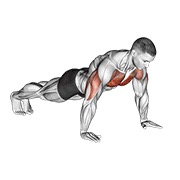
A single full-body session might look like this: goblet squat 3×8, push-up 3×10, dumbbell row 3×10, glute bridge 3×12, and a plank for 3 sets. That is it - short, balanced, and repeatable.

Rest days are when you grow
It is easy to assume that more training always means more results, but muscle is built during recovery, not during the workout itself. Training breaks down muscle fibers; rest, sleep, and nutrition repair them stronger. Skipping rest days does not speed up your progress - it slows it down and raises your injury risk. Treat your rest days as part of the plan, not as time off from it. Active recovery like walking, easy cardio, or light stretching is fine, but give trained muscles roughly 48 hours before hitting them hard again. Sleep and adequate protein do more for your gains than any extra session ever could.
Listen to your body
No schedule is set in stone. Some weeks you will feel strong and recovered; others, after poor sleep or high stress, you will feel drained. Persistent fatigue, declining performance, nagging aches, disrupted sleep, or a loss of motivation are signs you may need an extra rest day. Pulling back when your body asks for it is not weakness - it is what keeps you training for years instead of months. Auto-regulation, the practice of adjusting your plan to how you feel that day, is a mark of an experienced lifter, not a lazy one.
Common mistakes
Even motivated people sabotage their own progress in predictable ways:
- Doing too much too soon - jumping to five or six days as a beginner and burning out within weeks.
- Skipping rest days, then wondering why strength stalls and joints ache.
- Training the same muscles every session with no plan, leaving others neglected.
- Confusing soreness with productivity; soreness is not a reliable measure of a good workout.
- Ignoring sleep and nutrition while obsessing over the perfect schedule.
- Switching programs constantly instead of letting one run long enough to work.
Frequently asked questions (FAQ)
Is two days a week enough to see results? Yes, especially for beginners. Two well-structured full-body sessions can build noticeable strength and muscle if you are consistent and progressively add load over time. It is far better than an ambitious plan you cannot sustain.
Can I train every day? You can do some form of activity daily, but you should not train the same muscles hard every day. Rotate muscle groups, include genuine rest or light recovery days, and watch for signs of overtraining like persistent fatigue and declining performance.
Does more frequency build muscle faster? Up to a point. Once total weekly volume and recovery are accounted for, simply adding days yields diminishing returns. Quality, progression, and recovery matter more than raw frequency.
Summary
There is no single magic number, but the pattern is clear: beginners thrive on two to three days, most people land in the three-to-four-day sweet spot, and experienced lifters can use four to five days with a smart split. Whatever you choose, protect your rest days, prioritize sleep and nutrition, and adjust to how you feel. Ready to put it into practice? Explore our structured programs to follow a week that is already balanced for you, then keep progressing with progressive overload.
- Beginners: 2–3 days a week, full-body
- Most people: 3–4 days a week is the sweet spot
- Experienced: 4–5 days with a smart split
- Always include rest days - that is when you grow
- Adjust based on sleep, stress, and how you feel
Ready to put this into action? Start with a program for your level.
View programs →