Home workouts with no equipment for beginners
You do not need a gym to get stronger. Your own body weight is enough to build a real foundation, especially when you are starting out. All you need is a little floor space and a few minutes a few times a week. This article gives you a complete full-body circuit, tells you exactly how many sets and reps to do, and shows you how to keep it challenging for months.
Why bodyweight is perfect for beginners
Bodyweight training lets you focus on movement quality before you ever add external load. There is no equipment to set up, no gym to travel to, and very little that can go wrong. Because you control the difficulty with your own position and tempo, you can match the challenge to exactly where you are today and progress steadily as you improve. It is also the cheapest possible way to build the habit - and the habit is what produces results. For a wider view of how this fits into your overall plan, see the complete beginner's guide.
Warm up first
Never jump straight into your hardest reps cold. Spend three to five minutes raising your heart rate and loosening your joints: march in place, swing your arms, do a few slow bodyweight squats without weight, and roll your shoulders. A short warm-up improves your performance and lowers your injury risk. For a full routine, read our warm-up guide.
A full-body home circuit
Move through these exercises one after another with short rests. Together they cover your whole body - pushing, squatting, hinging, and bracing your core.
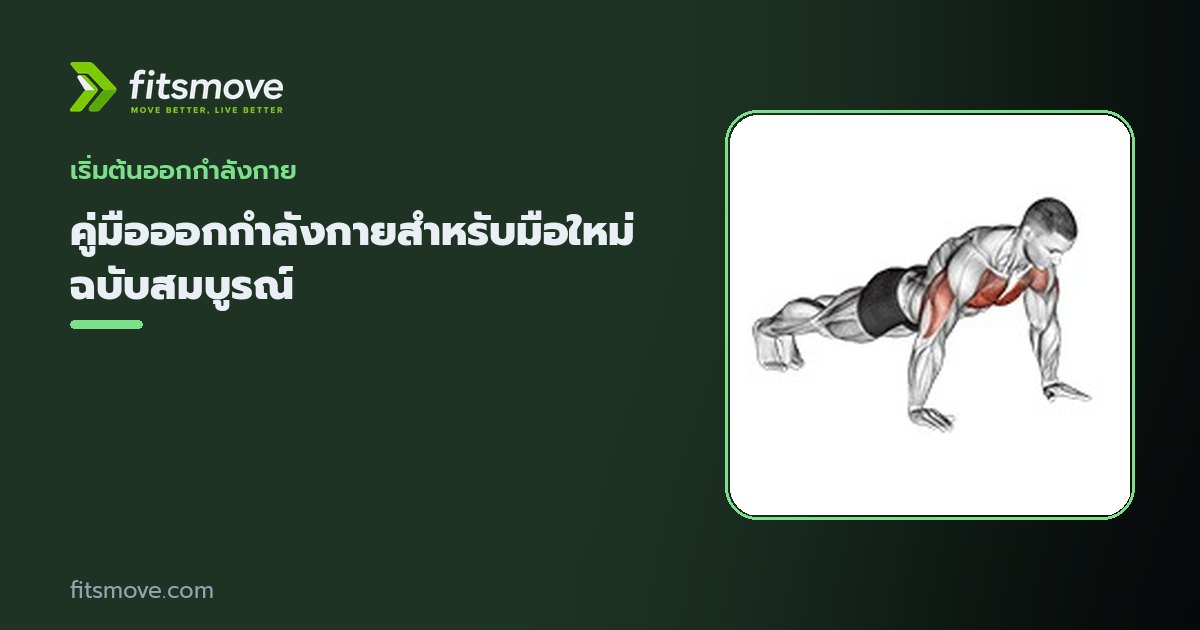
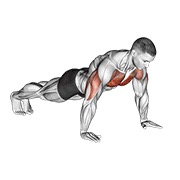
- The push-up trains your chest, shoulders, and arms. Drop to the kneeling push-up if a full push-up is too hard at first.
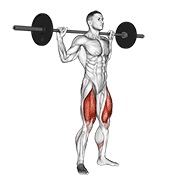
- The jump squat builds power and strength through your legs. Swap it for a regular bodyweight squat if jumping feels like too much.
- The front plank with twist challenges your core and trunk while keeping your spine stable.
- The low glute bridge on floor wakes up your glutes and supports a healthy lower back.
A sample 20-minute session
Here is how the circuit looks as a real session. Beginners can start with 2 rounds and build toward 3.
| Exercise | Reps / time | Rest |
|---|---|---|
| Push-up (or kneeling) | 8–12 | 45 sec |
| Bodyweight or jump squat | 10–15 | 45 sec |
| Front plank with twist | 20–30 sec | 45 sec |
| Low glute bridge | 12–15 | 60 sec |
Repeat the whole list 2–3 times. The whole session, warm-up included, fits comfortably into 20 minutes.
How many sets and reps
Aim for 2–3 rounds of the circuit. Within each round, do 8–12 reps of each strength move, and hold the plank for 20–30 seconds. Rest about 30–60 seconds between exercises and a little longer between rounds. Stop a set when your form starts to break down - quality matters more than the number on the page. If you want a deeper explanation of rep ranges, read sets and reps.
How to make it harder
As the circuit gets easier, add a challenge one step at a time. This is progressive overload applied to bodyweight training, and it is how you keep improving without any equipment.
- Add a round - go from 2 rounds to 3.
- Add reps - push from 8 toward 12, then 15.
- Slow the lowering phase - take three seconds to descend in each push-up and squat.
- Shorten your rest - trim 10–15 seconds off your breaks.
- Progress the movement - move from kneeling to full push-ups, or from squats to jump squats.
Increase only one thing at a time so your body adapts safely and you can tell what is working. A useful habit is to change just one variable each week and keep the rest steady - that way, if something feels off, you know exactly what to dial back.
How to track your progress
Without weights on a bar, it is easy to feel like nothing is changing. Keep a simple log so you can see the wins. Note the number of rounds, the reps you hit on each move, and how the session felt out of ten. Over a few weeks you will watch the numbers climb even when the mirror is slow to change. Small, recorded improvements - one more rep, one slower tempo, one extra round - are exactly the proof that the plan is working. If you want to understand the science behind steady increases, read progressive overload, and for how rest and food turn effort into results, see protein and recovery.
When to add equipment
Bodyweight training takes you a long way, but at some point added resistance makes progress simpler. A single pair of dumbbells unlocks moves like the dumbbell goblet squat and dumbbell bent-over row, letting you load your legs and back more directly. You do not need this to start - and you may not need it for months - but it is a natural next step once the hardest bodyweight variations stop challenging you. The structured 3-day-a-week split is a great place to use them.
Common mistakes
- Rushing the reps. Bouncing through movements removes the very tension that builds strength. Control every rep.
- Sagging hips in the plank. Squeeze your glutes and brace your core so your body stays in one straight line.
- Half-depth squats. Sit down until your thighs are roughly parallel, as long as it is pain-free, to train the full range.
- Never progressing. If the workout feels identical for weeks, it has stopped challenging you - add a variable.
- Skipping rest days. Muscle is built between sessions; train this circuit 3–4 times a week, not daily.
Frequently asked questions (FAQ)
Can I really build muscle without weights? Yes, especially as a beginner. Once basic moves become easy, you keep progress going by using harder variations, more reps, and slower tempos.
How often should I do this circuit? Three to four non-consecutive days a week works well. Leave at least a day between sessions so you recover. See how many days per week.
What if a push-up is still too hard? Start with the kneeling push-up or push-ups against a wall, then progress as you get stronger.
Summary
A small patch of floor and a few focused minutes are all you need to start getting stronger. Warm up, run the circuit with clean form, recover between sessions, and add one small challenge whenever it feels easy. When you are ready for a structured plan, follow one of our beginner programs or step up to the 3-day-a-week split. If anything causes sharp pain, stop and consider checking with a professional.
Ready to put this into action? Start with a program for your level.
View programs →