

How many sets and reps? Choose by goal
"How many sets and reps should I do?" is one of the first questions every lifter asks, and the honest answer is: it depends on your goal. There's no single magic number that works for everyone, but there are well-established ranges that suit different aims. Once you understand what sets, reps, load, and rest actually do, you can build a session that points your effort exactly where you want it to go. This guide breaks down each variable, gives you concrete starting numbers, and shows how to put them together.
Think of these numbers as a starting point, not a law. Your body, recovery, and experience all matter. Begin with the ranges below, track your results, and adjust based on how you respond.
The four variables that matter
Every set you do is defined by four dials, and changing one changes the training effect:
- Reps (repetitions): how many times you perform the movement in one set. Lower reps with heavier weight bias strength; higher reps with lighter weight bias endurance.
- Load (weight): how heavy the resistance is. Load and reps are linked - heavier weight means fewer possible reps.
- Sets: how many rounds of reps you do for an exercise. More sets generally means more volume and more stimulus, up to a point.
- Rest: how long you pause between sets. Longer rest lets you lift heavier; shorter rest raises the metabolic demand.
Master these four and you can dial any workout toward any goal. Everything below is just specific combinations of these dials.
By goal: rep ranges
The classic rep-range framework maps neatly to three common goals. These overlap more than people think - building muscle also builds strength, for instance - but the emphasis differs:
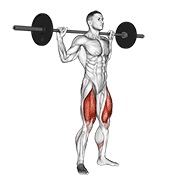
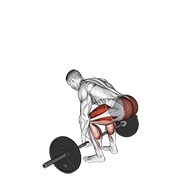
- Strength: 3–6 reps, heavy load, rest 2–3 min. Trains your nervous system to produce force. Best on big lifts like the barbell deadlift and barbell full squat.
- Hypertrophy (muscle size): 8–12 reps, moderate load, rest 60–90 sec. The sweet spot for most people who want to look and feel more muscular. Works well on the barbell bench press, dumbbell bent-over row, and dumbbell biceps curl.
- Endurance: 15+ reps, lighter load, short rest. Builds muscular stamina and is friendly for bodyweight moves like the push-up and the front plank with twist.
Most general trainees do well living mostly in the 8–12 hypertrophy range, with some heavier 5-rep work and some lighter higher-rep work mixed in.
Quick reference table
Here's the whole framework at a glance:
| Goal | Reps | Load | Rest | Best for |
|---|---|---|---|---|
| Strength | 3–6 | Heavy | 2–3 min | Big compound lifts |
| Muscle (hypertrophy) | 8–12 | Moderate | 60–90 sec | Most lifters, most exercises |
| Endurance | 15+ | Light | 30–60 sec | Bodyweight, conditioning |
Use heavier, lower-rep work on big lifts that train the upper legs, chest, and back, and save the lighter, higher-rep work for smaller muscles like the upper arms and the waist.
And how many sets?
Beginners do well with 2–3 working sets per exercise; experienced lifters may use 3–5. But the number per exercise matters less than the total weekly volume per muscle group - usually counted as total hard sets per muscle across the week. A common, evidence-aligned target is roughly 10–20 hard sets per muscle group per week, spread over two or more sessions.
For example, if you train chest twice a week with bench press and push-ups, doing 3 sets of each per session gives you about 12 weekly sets - right in the productive range. Beginners should start at the lower end and add sets gradually as they recover well; this gradual increase is itself a form of progressive overload, which you can read more about in our progressive overload guide.
Leave 1–2 reps in reserve
You don't need to go to failure every set. Stopping 1–2 reps short of failure - a concept called "reps in reserve" or RIR - preserves your form, protects your joints, and lets you recover faster so you can train hard again sooner. Training to absolute failure on every set is exhausting, raises injury risk, and isn't necessary for most of your gains.
A simple rule: on your main heavy lifts, keep 1–2 reps in the tank. You can occasionally push closer to failure on safer isolation moves like the biceps curl, where a missed rep just means setting the dumbbell down. Quality, controlled reps with a little in reserve beat grinding, sloppy reps every time. If form is breaking down, the set is over - see our form before weight guide.
Putting it together: a sample session
Here's how a hypertrophy-focused full-body session might look, mixing rep ranges sensibly - heavier on the big lift, moderate on the rest:
- Barbell squat - 3 sets x 5–6 reps (strength bias), rest 2 min
- Bench press - 3 sets x 8–10 reps, rest 90 sec
- Dumbbell row - 3 sets x 8–10 reps, rest 90 sec
- Biceps curl - 2 sets x 12–15 reps, rest 60 sec
- Plank with twist - 2–3 sets to a controlled stop
See more real set and rep prescriptions in our programs, and if you're just getting started, the beginner program lays it all out for you.
ข้อผิดพลาดที่พบบ่อย (Common mistakes)
- Always training to failure. It feels hardcore but hammers recovery and form. Leave 1–2 reps in reserve on most sets.
- Counting reps in a vacuum. Ten easy reps and ten near-limit reps are not the same. Load and effort matter as much as the number.
- Chasing one "perfect" rep range. Goals overlap; variety across rep ranges is usually better than living in just one.
- Ignoring weekly volume. Focusing only on per-exercise sets while neglecting total weekly sets per muscle is a common blind spot.
- Resting too little on heavy lifts. Under-resting before a heavy set means you can't lift the load that drives strength.
คำถามที่พบบ่อย (FAQ)
Are higher reps or lower reps better for building muscle? Both can build muscle if the effort is hard enough. The 8–12 range is a practical, time-efficient sweet spot, but anywhere from about 6 to 20 reps works well when taken close to failure.
How long should I rest between sets? Roughly 2–3 minutes for heavy strength work, 60–90 seconds for hypertrophy, and 30–60 seconds for endurance. Rest long enough to perform the next set with good form.
How many total sets per week per muscle? A common productive range is about 10–20 hard sets per muscle group per week. Start lower, add gradually, and adjust based on recovery.
สรุป (Summary)
There's no universal magic number, but there is a clear framework: pick your rep range by goal (3–6 for strength, 8–12 for muscle, 15+ for endurance), set your load and rest to match, aim for sensible weekly volume per muscle, and leave 1–2 reps in reserve to protect form and recovery. Use the table above as your cheat sheet, track what you do, and adjust. Ready to apply it? Browse our programs for ready-made set and rep schemes, and pair this with our progressive overload guide to keep those numbers climbing.
Ready to put this into action? Start with a program for your level.
View programs →