

The Upper/Lower split for busy lifters
Most lifters do not have six days a week to spend in the gym. Between work, family, and everything else, four days is often the realistic ceiling. The good news is that you do not need six days to build a strong, muscular body. The Upper/Lower split was built for exactly this situation: it divides your training into two simple sessions, the upper body and the lower body, then runs each one twice a week. That gives you the high training frequency that drives growth while still fitting inside a busy schedule.
This guide explains the principle behind Upper/Lower, gives you a ready-to-use 4-day schedule, compares it directly to the popular Push/Pull/Legs split, and walks through the common mistakes that hold people back. By the end you will know how to build an Upper/Lower week that respects both your goals and your calendar. For a broader look at how splits compare, see our Push/Pull/Legs guide, and for the bigger picture, our complete muscle building guide.
The principle behind Upper/Lower
The Upper/Lower split divides the entire body into two halves. Upper days train everything above the waist: the chest, the back, the shoulders, and the arms. Lower days train everything below: the quads, the hamstrings, the glutes, and the calves, usually with some core work added. You then alternate these two sessions across the week, hitting each half twice in a typical four-day layout.
This structure is efficient because it strikes a balance that other splits miss. A full-body routine trains everything every session but can feel rushed when you only have an hour. A six-day split spreads things thin across more days than most people can attend. Upper/Lower sits neatly in between: each muscle group is trained twice a week, which research consistently links to better growth than once a week, but the whole plan fits into four sessions you can actually keep.
There is a second, quieter benefit. Because each session covers a large chunk of the body, you are never far from training any given muscle. Miss a day and the next upper or lower session is rarely more than a couple of days away, so a single skipped workout does not blow a hole in your week the way it can with a six-way split. For people whose schedules shift week to week, that resilience matters as much as the raw training math.
What goes into each day
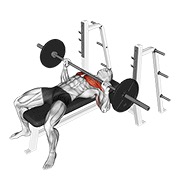
An upper day is anchored by one or two big pressing and pulling movements, then supported by accessory work. The barbell bench press covers the chest and triceps, a heavy row or pulldown builds the back, and the seated overhead press develops the shoulders. Add a curl and a triceps movement and the upper body is fully covered.

A lower day is built around the two biggest lower-body lifts. The barbell full squat trains the quads and glutes through a deep range, while the barbell deadlift hammers the hamstrings, glutes, and the entire posterior chain. Supporting these with some single-leg work and calf raises rounds out the upper legs and below. Two big lifts plus a few accessories is all a productive lower day needs.
A sample 4-day Upper/Lower schedule
The classic way to run Upper/Lower is four days a week, alternating upper and lower with rest days placed for recovery. Here is a clean weekly layout.
| Day | Session | Main lifts |
|---|---|---|
| Day 1 | Upper | Bench press, row, overhead press |
| Day 2 | Lower | Squat, Romanian deadlift, calves |
| Day 3 | Rest | Recovery |
| Day 4 | Upper | Incline press, pulldown, curls and triceps |
| Day 5 | Lower | Deadlift, lunges, calves |
| Day 6 | Rest | Recovery |
| Day 7 | Rest | Recovery |
This layout trains each half of the body twice a week with plenty of recovery built in. If you can only manage three days, run the sessions in a rolling order (upper, lower, upper, then lower, upper, lower the next week) so each session lands twice every two weeks. The split bends easily to fit the days you actually have.
Upper/Lower compared to Push/Pull/Legs
The two most popular intermediate splits are Upper/Lower and Push/Pull/Legs, and the main difference is how many days they need. PPL divides the body into three sessions and shines over six days, giving lots of focused volume per muscle. Upper/Lower divides the body into two sessions and shines over four days, packing more muscle groups into each workout.
For a busy lifter, that difference is decisive. If you can reliably train six days, PPL offers more room to specialise. If four days is your realistic limit, Upper/Lower gives you twice-weekly frequency without forcing a sixth session you will eventually skip. Neither is superior in a vacuum: the best split is the one that matches the days you can genuinely commit, and for most people with full schedules, that is Upper/Lower.
Making Upper/Lower work over the long term
The structure only pays off if you apply progressive overload week after week. Each upper and lower session should aim to beat the last over time, whether by adding a little weight, an extra rep, or another clean set. Because each session repeats twice a week, you get frequent chances to push your numbers up, which is one of the quiet advantages of this split.
Recovery still matters even on four days. Two heavy lower sessions a week is demanding on the legs and lower back, so space them out and keep your sleep and protein in line, a topic our protein and recovery guide covers in detail. If a lower day still feels heavy by the time the next one arrives, move your rest days around or trim a set. A split you recover from and repeat for months will always beat one that leaves you constantly sore. Pick a structured intermediate program and let the consistency compound.
ข้อผิดพลาดที่พบบ่อย (Common mistakes)
- Cramming too much into one session. Upper days can balloon into 15 exercises. Pick a few big lifts and a handful of accessories, then stop.
- Stacking the two lower days back to back. Heavy squats and deadlifts need recovery. Keep a rest day between them.
- No progression. Repeating the same weights every week wastes the structure. Aim to beat your previous session over time.
- Neglecting the upper back. It is easy to over-press and under-pull. Balance your bench work with plenty of rows and pulldowns.
- Forcing six days onto a four-day life. If four days is your ceiling, an honest four-day Upper/Lower beats a six-day plan you abandon.
คำถามที่พบบ่อย (FAQ)
Is Upper/Lower good for beginners? It can work, but most true beginners do even better on a simple full-body plan three days a week. Upper/Lower becomes a great choice once you want more volume and can commit to four sessions a week with consistent progressive overload.
Can I run Upper/Lower on three days? Yes. Run the sessions in a rolling order so each lands twice every two weeks. You lose a little frequency compared to the four-day version, but it still works well for many lifters.
Upper/Lower or Push/Pull/Legs? Choose by your available days. Four days favours Upper/Lower, six days favours Push/Pull/Legs. Match the split to the schedule you can actually keep, not the one you wish you had.
สรุป (Summary)
The Upper/Lower split is the practical answer for busy lifters. It divides the body into two clean sessions, trains each half twice a week, and fits comfortably into four training days while still delivering the frequency that drives growth. It rewards consistent progressive overload, demands sensible recovery, and bends easily to three or four days depending on your week. Ready to put it into practice? Pick a structured program and build your Upper/Lower week with confidence.
Ready to put this into action? Start with a program for your level.
View programs →