

How to grow stubborn calves
Few muscles frustrate lifters like the calves. People who build impressive arms, chests, and backs often still stand on a pair of lower legs that refuse to grow, no matter how many sets they throw at them. The calves earn their reputation as the most stubborn muscle in the body, and a lot of that frustration comes from training them the wrong way: a few half-hearted, bouncy sets at the end of a workout, with no stretch, no control, and no real progression.
The good news is that stubborn calves are rarely impossible calves. They simply demand a smarter approach than most people give them. This guide explains why calves resist growth, how a full range of motion changes everything, why higher training frequency works so well, a ready-to-use sample plan, and the common mistakes that keep lower legs small. For the full menu of lower-leg movements, browse the lower legs category any time.
Why calves are so stubborn
Two factors make calves harder to grow than other muscles. The first is genetics, and it is real. The shape of your calf is largely determined by where the muscle belly ends and the tendon begins. People with long muscle bellies that run low toward the ankle have an easier time building thick, full calves, while those with short bellies and long tendons face a steeper climb. You cannot change your tendon length, but you can still maximise the muscle you have.
The second factor is daily use. Your calves carry your bodyweight every time you walk, climb stairs, or stand, which means they are already used to constant low-level work. A muscle that is used to thousands of light contractions every day is not impressed by a few easy sets in the gym. To force growth, you have to give the calves a stimulus that clearly exceeds their daily workload: heavier loads, a much fuller range of motion, real intensity, and enough volume across the week. Knowing this turns the calves from a mystery into a simple, if demanding, problem to solve.
Train through a full range of motion
If you change one thing about your calf training, make it the range of motion. The single most common reason calves fail to grow is short, bouncy reps that barely move the ankle. To grow, the calf needs to travel through its full available range on every rep: a deep stretch at the bottom and a hard squeeze at the top.
The standing calf raise is the cornerstone exercise here, and it shines when done with a full range. Lower your heels as far as they will comfortably go to load the muscle in a deep stretch, pause for a moment, then drive all the way up onto the balls of your feet and squeeze hard at the top. The stretch at the bottom is where much of the growth stimulus comes from, so never cut it short. Slow the tempo right down, especially on the way down, and treat each rep as a deliberate, controlled effort rather than a bounce. A handful of full, controlled reps beats fifty sloppy ones every time.
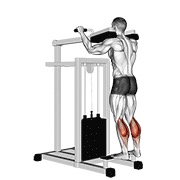
Why high frequency works for calves
Because the calves are built for endurance and recover quickly, they respond better than almost any other muscle to frequent training. Training them just once a week, the way you might train chest or back, leaves a lot of growth on the table. Most people see far better results hitting the calves two, three, or even four times a week.
This higher frequency lets you accumulate more quality volume across the week without each session becoming exhausting. It also gives the calves repeated growth signals, which suits a muscle that bounces back fast. The key is that each session must still be hard and full-range, not just going through the motions. Spread your weekly calf volume across several short, intense sessions rather than one long one, and apply progressive overload by slowly adding weight or reps over time. Our guide to sets and reps explains how to structure this volume sensibly.
A sample calf plan
Here is a simple, high-frequency approach that prioritises full range of motion and steady progression. Add this to the end of your workouts on several days through the week.
| Day | Exercise | Sets x Reps | Tempo |
|---|---|---|---|
| Day 1 | Standing calf raise | 4 x 8–12 | Slow, deep stretch |
| Day 2 | Standing calf raise | 3 x 15–20 | Controlled, full range |
| Day 3 | Standing calf raise | 4 x 10–15 | Heavy, pause at bottom |
Vary the rep ranges across the week so the calves face both heavier, lower-rep work and lighter, higher-rep work. The non-negotiable detail in every session is the same: a full stretch at the bottom, a hard squeeze at the top, and a controlled tempo throughout.
Programming calves into your week
Calves fit almost anywhere because they recover quickly and do not interfere with your other training. The simplest method is to tack two or three short calf sessions onto the end of workouts you are already doing, for example after leg day, after an upper-body day, and after a third session. This spreads the volume out and keeps each effort fresh.
Consistency matters more than any single brutal session. The lifters who finally grow their calves are usually the ones who train them hard and often for months on end, never skipping them as an afterthought. Keep the loads progressing, keep the range full, and give the calves at least a day between heavy sessions even though they recover fast. Pair this consistent training with enough total food and protein to support growth, which our protein and recovery guide covers, and even stubborn calves will slowly respond.
ข้อผิดพลาดที่พบบ่อย (Common mistakes)
- Bouncing through partial reps. The most common calf mistake by far. Short, springy reps barely load the muscle. Use a full range with a deliberate stretch and squeeze.
- Training calves only once a week. Calves recover fast and thrive on frequency. Two to four sessions a week beats a single hard day.
- No progression. Doing the same weight for the same reps forever stalls growth. Add load or reps over time like any other muscle.
- Rushing the tempo. Fast reps use momentum, not muscle. Slow down, especially on the lowering phase.
- Giving up too soon. Calves are slow to change. Many people quit after a few weeks when months of consistent work are what they need.
คำถามที่พบบ่อย (FAQ)
Can anyone build bigger calves, or is it all genetics? Genetics set the ceiling and the shape, but almost everyone can build noticeably bigger calves with full-range, high-frequency, progressive training over time. The people who fail usually trained them poorly, not impossibly.
How often should I train calves? Two to four times a week works well for most people because calves recover quickly. Spread short, intense sessions across the week rather than relying on one.
Why does the stretch at the bottom matter so much? Loading a muscle in a deep stretch is a powerful growth stimulus, and the calf is no exception. Cutting the bottom of the rep short removes one of the most productive parts of the movement.
สรุป (Summary)
Stubborn calves grow when you stop training them as an afterthought and start training them with intent: a full range of motion with a deep stretch on every rep, a controlled tempo, higher frequency across the week, and steady progressive overload over months. Build your calf training around full-range standing calf raises, train them several times a week, and stay patient. Ready to fit this into a complete routine? Pick a structured intermediate program and finally give your lower legs the attention they need.
Ready to put this into action? Start with a program for your level.
View programs →