Build bigger arms: biceps & triceps
Bigger arms are perhaps the single most requested result in any gym - and the one most people go about backwards. They pour endless sets into curls, obsess over the biceps, and barely touch the triceps, then wonder why their arms still look small in a t-shirt. The truth is that the triceps make up roughly two-thirds of your upper arm. If you want bigger arms, the triceps are where most of the size lives.
This guide explains the anatomy that should shape your training, the core movements for both the biceps and triceps, clear guidance on sets and reps, a ready-to-use sample plan, and the mistakes that quietly keep most people's arms small. For the full menu of options, browse the upper arms category any time.
A short tour of arm anatomy
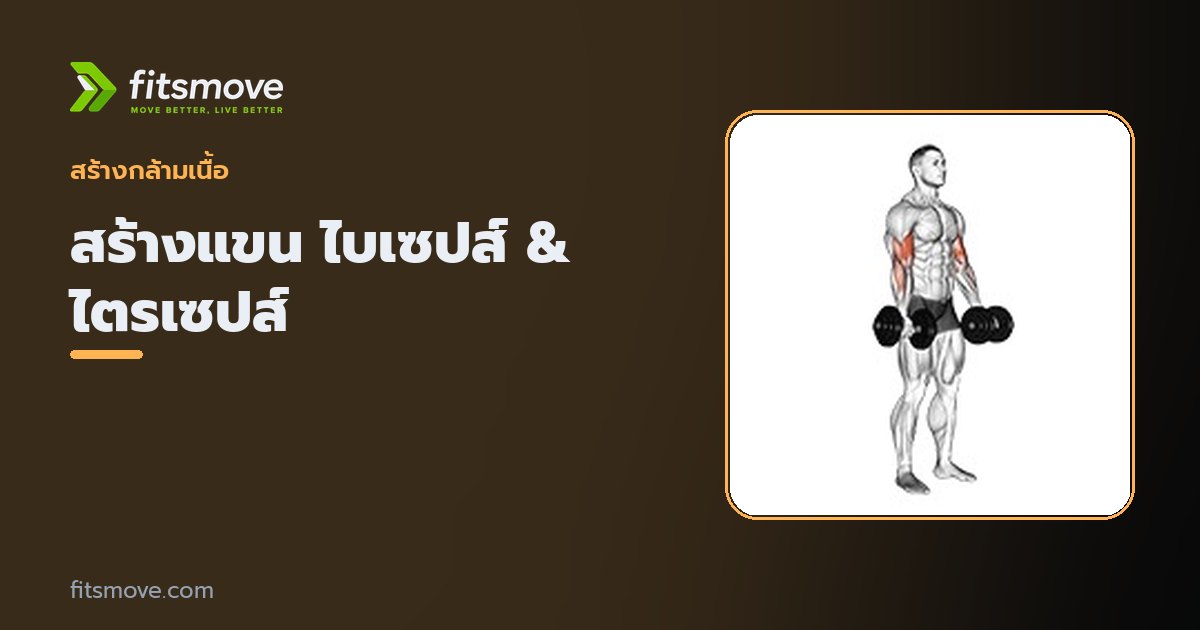
Your upper arm is built from two main muscles. On the front sits the biceps brachii, a two-headed muscle that bends the elbow and turns the palm up - the muscle everyone flexes in the mirror. On the back, and considerably larger, sits the triceps brachii, a three-headed muscle that straightens the elbow. Because the triceps is bigger, building it has a larger effect on overall arm size than chasing the biceps alone.
The practical takeaway is simple: train both, but give the triceps at least as much attention as the biceps. The biceps are best built with curling movements that bend the elbow under load, while the triceps are best built with pressing and extension movements that straighten the elbow. A balanced arm routine includes both patterns, and the lifters with the most impressive arms almost always have well-developed triceps doing the heavy lifting.
The core movements
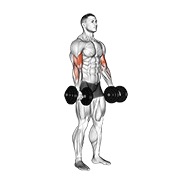
For the biceps, the dumbbell biceps curl is the foundation. Curling a dumbbell in each hand lets you work both arms independently, turn the palm up through the movement for a full contraction, and train the biceps through a complete range of motion. It is simple, scalable, and hard to do wrong - exactly what you want from a primary biceps exercise.
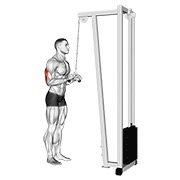
For the triceps, the cable triceps pushdown with a V-bar is one of the best and most joint-friendly choices. The cable keeps constant tension on the muscle throughout the movement, the V-bar sits comfortably in the hands, and pushing the bar down to a full lockout trains the triceps hard with minimal stress on the elbows. Because the triceps make up most of your arm, this movement does more for overall size than any single curl.
How to set sets and reps
Arms are smaller muscles that respond well to moderate and higher rep ranges. Train both the biceps and triceps mostly in the 8 to 15 rep range, with the option to dip to 6 to 8 reps on a heavier movement and push to 15 to 20 reps on a lighter finisher. Take working sets close to failure - leaving one to three reps in reserve - but keep the movement strict, since arms are easy to cheat with momentum.
As a weekly target, aim for roughly 10 to 16 hard sets for the biceps and a similar amount for the triceps. Remember that the triceps already get work from any pressing you do, and the biceps from any pulling, so your direct arm work adds to that base rather than replacing it. Rest 60 to 90 seconds between sets. Progress using progressive overload: add a rep or a little weight whenever you hit the top of your range with clean form. Our sets and reps guide explains the reasoning behind these numbers.
A sample arm plan
Here is a balanced arm session that gives the triceps and biceps roughly equal volume, with the triceps slightly favoured for overall size. Run it once or twice a week, progressing the loads over time.
| Exercise | Sets x Reps | Rest | Focus |
|---|---|---|---|
| Cable triceps pushdown (V-bar) | 4 x 10–12 | 90 sec | Triceps, overall arm size |
| Dumbbell biceps curl | 4 x 8–12 | 90 sec | Biceps |
| Cable triceps pushdown (lighter) | 2 x 15–20 | 60 sec | Triceps finisher |
| Dumbbell biceps curl (slow) | 2 x 12–15 | 60 sec | Biceps finisher |
Beginners can simplify this to one curl and one pushdown. The structure matters more than the exact exercise - train both muscles, and do not let the biceps steal all your attention.
Programming arms into your week
Where direct arm work sits depends on your split. On a push/pull/legs plan, triceps train on push day with chest and shoulders, while biceps train on pull day with the back - both get a base of indirect work plus your direct sets. On an upper/lower plan, arms share the upper day. On full-body training, you simply add a curl and a pushdown when you have the energy. The goal in every case is the same: hit each muscle about twice a week with enough quality sets and adequate recovery.
Be honest about how much your arms are already worked. Every press hits the triceps and every pull hits the biceps, so if you are training your whole body sensibly, your arms are getting more work than you think. Direct arm work is the icing, not the cake - a handful of strict, hard sets does far more than endless half-rep curls done out of habit. If you fit arm training into a complete plan built on our muscle building guide, you will rarely need more than two focused arm sessions a week to keep growing.
ข้อผิดพลาดที่พบบ่อย (Common mistakes)
- Neglecting the triceps. The triceps are most of your arm, yet they get a fraction of the attention. Train them at least as hard as the biceps.
- Swinging the curl. Heaving the weight up with your back and hips takes tension off the biceps. Curl with strict form and a controlled lower.
- Half range of motion. Cutting curls and pushdowns short robs the muscle of its most productive portions. Move through a full range you control.
- Going too heavy. Arms are small muscles - loading beyond what you can move cleanly turns the exercise into a swing. Pick a weight you can control.
- Endless volume. More sets are not always better. A focused dose of quality work beats junk volume your arms cannot recover from.
คำถามที่พบบ่อย (FAQ)
Why aren't my arms growing even though I curl a lot? Most likely because you are neglecting the triceps, which make up roughly two-thirds of your upper arm. Add direct triceps work like the cable pushdown and your arms will respond.
How often should I train arms? About twice a week of direct work is plenty for most people, on top of the indirect work your arms get from pressing and pulling. More frequency only helps if you can recover from it.
Do I need lots of different arm exercises? No. A reliable curl and a reliable pushdown, progressed over time, cover the bulk of what you need. The dumbbell curl and the V-bar pushdown are an excellent, simple pairing.
สรุป (Summary)
Bigger arms come from training both the biceps and triceps, with the triceps given at least as much attention since they make up most of your upper arm. Use a curl and a pushdown as your foundation, work mostly in the 8 to 15 rep range with strict form, hit each muscle about twice a week, and progress steadily over months. Keep your reps clean and let progressive overload do the slow, reliable work. Ready to fit this into a complete routine? Pick a structured intermediate program and stop spinning your wheels on endless curls.
Ready to put this into action? Start with a program for your level.
View programs →