Build bigger legs: squats and beyond
Big, balanced legs are the foundation of a strong, athletic physique - yet they are the most commonly skipped muscle group in the gym. The reasons are familiar: leg training is hard, it leaves you sore, and the results are hidden under trousers most of the time. But strong legs underpin almost everything you do, from sprinting and jumping to simply standing up out of a chair at eighty. They also drive a huge share of your total muscle and strength, so neglecting them caps how strong and how big you can ever get up top. Train them well and the rest of your body follows.
This guide gives you a short tour of leg anatomy so your exercise choices make sense, the core movements that build real size and strength, clear guidance on how to structure your sets, a ready-to-use sample plan, and the mistakes that quietly keep most people's legs small. For the full menu, browse the upper legs category and the lower legs category any time.
A short tour of leg anatomy
Your legs are not one muscle but several large groups working together. The quadriceps sit on the front of your thigh and extend the knee - they do the heavy lifting in any squat or lunge. The hamstrings run down the back of the thigh, bending the knee and extending the hip, and they are best loaded by hinging movements. The glutes, the most powerful muscles in the body, drive hip extension and stabilise everything from squats to sprints.
Below the knee, the calves - the gastrocnemius and the deeper soleus - point the foot and give the lower leg its shape. A complete leg routine trains all of these. Quad-dominant exercises like squats build the front, hip-hinge exercises like the Romanian deadlift build the back, single-leg work like lunges balances both while exposing weaknesses, and calf raises finish the job below the knee.
The core movements
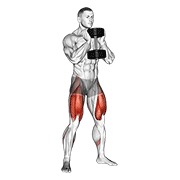
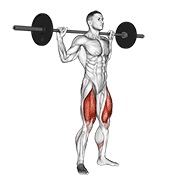
A handful of exercises do most of the work. The barbell full squat is the king of lower-body training - it loads the quads, glutes, and hamstrings under a heavy bar and lets you progress for years, making it the backbone of serious leg development. If a loaded bar on your back is too much to start with, the dumbbell goblet squat teaches the same movement with the weight held in front, which keeps your torso upright and is far easier to learn.
For the back of the legs, the barbell Romanian deadlift is the gold standard. Hinging at the hips with a soft knee, you lower the bar along your thighs and feel a deep stretch in the hamstrings before driving back up - this is the movement that builds the rear of your legs and your glutes. The forward lunge adds single-leg work that improves balance, evens out left-right differences, and hammers the quads and glutes through a long range of motion. Finally, the standing calf raise trains the lower leg directly, which most lifters neglect entirely.
How to set sets and reps
Anchor your leg sessions with a heavy compound - usually the squat - in the 5 to 8 rep range to build strength and tension. Then add volume with hinges, lunges, and lighter squat variations in the 8 to 15 rep range. Calves respond well to higher reps, often 12 to 20, with a deliberate pause and stretch at the bottom of each rep.
As a weekly target, aim for roughly 10 to 16 hard sets for the quads and a similar amount for the hamstrings and glutes, split across two sessions for better results than one punishing day. Rest two to three minutes after heavy squats and one to two minutes on accessory work. Progress using progressive overload: add a little weight or a rep whenever you hit the top of your range with clean form. Our complete muscle building guide explains the principles behind these numbers.
A sample leg plan
Here is a balanced leg session that covers the quads, hamstrings, glutes, and calves with both heavy and higher-rep work. Run it once or twice a week, progressing the loads over time.
| Exercise | Sets x Reps | Rest | Focus |
|---|---|---|---|
| Barbell full squat | 4 x 5–8 | 2–3 min | Heavy strength, quads and glutes |
| Romanian deadlift | 3 x 8–10 | 2 min | Hamstrings and glutes |
| Goblet squat | 3 x 10–12 | 90 sec | Quads, range of motion |
| Forward lunge | 3 x 10–12 each leg | 90 sec | Single-leg balance, glutes |
| Standing calf raise | 4 x 12–20 | 60 sec | Calves |
Beginners can simplify this to a goblet squat, a Romanian deadlift, and a calf raise. The structure matters more than the exact exercise - a heavy squat pattern, a hinge, some single-leg work, and calves.
Programming legs into your week
Where leg day sits depends on your split. On a push/pull/legs plan, legs get their own dedicated day. On an upper/lower plan, they share the lower day with any direct ab work. On full-body training, you simply include one squat pattern and one hinge each session. The goal in every case is the same: hit the legs about twice a week with enough quality sets and at least 48 hours of recovery in between, since large muscles take longer to bounce back.
Respect the recovery cost of heavy leg work. Squats and deadlifts tax your whole body, not just your legs, so building volume too quickly leaves you flat for every other session. Build up gradually, keep your technique sharp, and treat deep soreness as feedback rather than a badge of honour. Pay attention to sleep and food too - large muscle groups recover and grow on the back of enough total calories and protein, which our protein and recovery guide covers in detail. A great leg session you cannot recover from is worse than a slightly easier one you can repeat next week.
ข้อผิดพลาดที่พบบ่อย (Common mistakes)
- Skipping leg day. The most common mistake of all. Legs are half your body - train them with the same seriousness as your upper body.
- Quarter squats. Cutting the depth short to lift more weight robs the quads and glutes of their most productive range. Squat to at least parallel with control.
- Rounding the back on the RDL. A rounded lower back under load is where injuries happen. Keep a neutral spine and hinge from the hips.
- Never training the back of the legs. Squats alone leave the hamstrings underdeveloped. Include a hinge like the Romanian deadlift every week.
- Ignoring calves and single-leg work. Both fill in the gaps that bilateral squatting leaves behind. Do not skip them.
คำถามที่พบบ่อย (FAQ)
Are squats enough to build my legs? Squats are the best single exercise, but they emphasise the quads and glutes and under-train the hamstrings. Pair them with a hinge like the Romanian deadlift and some single-leg work for complete legs.
My knees hurt when I squat. What now? Reduce the load, work on squatting with control, and make sure your depth and stance suit your body. Start with the goblet squat to groove the pattern, and avoid squatting into sharp pain.
How often should I train calves? Calves recover quickly and tolerate frequent work well. Training them two to three times a week with high reps and a full stretch at the bottom usually produces the best results.
สรุป (Summary)
Bigger legs come from training the quads, hamstrings, glutes, and calves through a full range of motion, mixing heavy squats with hinges, lunges, and calf work, hitting the legs about twice a week, and progressing steadily over months. Use a heavy squat, a Romanian deadlift, single-leg work, and calf raises as your foundation, keep your form clean, and let progressive overload do the slow, reliable work. Ready to fit this into a complete routine? Pick a structured intermediate program and stop skipping leg day for good.
Ready to put this into action? Start with a program for your level.
View programs →