Exercise order in a workout
Two people can do the exact same six exercises in a session and get very different results, simply because they ran them in a different order. That is not a small detail. The sequence you choose decides which lifts get your freshest energy, which muscles are already tired when their turn comes, and where your risk of sloppy form is highest. Get the order right and every rep lands where you want it. Get it wrong and your most important lift suffers because you burned yourself out on something minor first.
This guide gives you a clear framework for ordering any workout. We cover the main rule of compounds before isolation, why big and priority lifts come first, how to slot in your weak points, a sample order you can copy, and the one common exception worth knowing. If you are still deciding what belongs in your program at all, start with how to build your own program, then use this article to arrange it.
Why order matters at all
Every set you perform draws down two resources: the freshness of the specific muscles you are working, and the freshness of your nervous system as a whole. Both are highest at the start of a session and decline as you go. A heavy compound lift late in a workout is not the same movement it would have been first: the weight feels heavier, your coordination is worse, and your form breaks down sooner. That is fatigue talking, not weakness.
The whole logic of exercise order is about spending your freshest energy on the work that needs it most and demands it most. Small, forgiving movements can wait, because they stay perfectly productive even when you are tired. Big, technical, dangerous-if-sloppy movements cannot wait. Once you see the session as a budget of energy that only shrinks, the correct ordering becomes obvious.
Rule one: compounds before isolation
The single most reliable rule is to do your compound lifts before your isolation lifts. Compound movements bend several joints and train multiple muscles at once, which means they need heavy weight, sharp coordination, and a fresh nervous system to be done well. Isolation movements bend one joint and target a single muscle, so they are far more forgiving of fatigue.
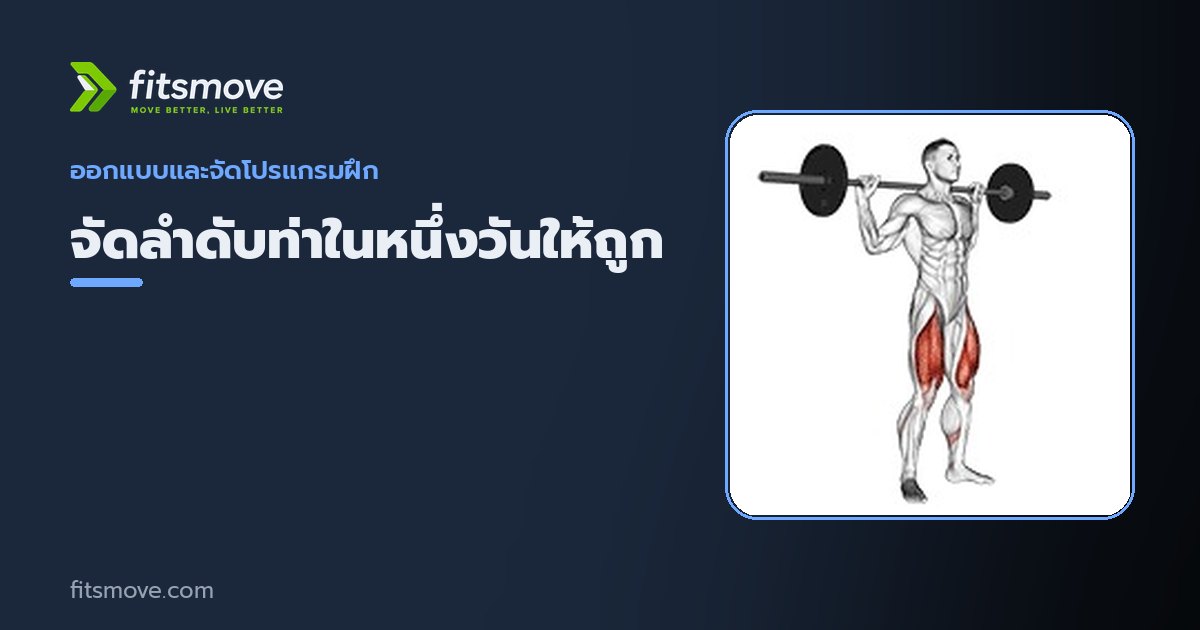
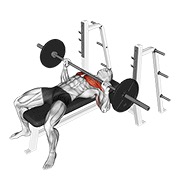
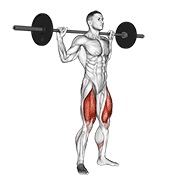
Put concretely, that means a session leads with lifts like the barbell squat, barbell bench press, and barbell deadlift, and finishes with lifts like the dumbbell biceps curl and lateral raise. If you flip that and curl first, your arms are pre-fatigued and your pressing weight drops, so you trade a big lift's productivity for a small one's. That is a bad trade almost every time.
Rule two: big and priority lifts first
Compound before isolation is the baseline, but within your compounds there is a second layer of ordering. The lift that matters most to your goal, and the lift that is heaviest or most technical, should come first. If your goal this block is a stronger squat, the squat leads the session, even ahead of other compounds, because you want it done while your legs and focus are fully fresh.
This is also how you fix a lagging body part. Whatever muscle you most want to grow should get the first, most focused work of the session, when you can push it hardest and connect with it best. Bury your priority at the end and it only ever gets your leftovers. This ties directly into your weekly plan: the more a muscle matters to you, the earlier it should appear and the more training frequency per muscle it should get across the week.
Where warm-ups and weak points fit
Order does not start with your first heavy set. It starts with a proper warm-up that raises your body temperature and primes the movements you are about to load. On top of a general warm-up, your first heavy exercise should be led into with a few lighter warm-up sets so you reach your working weight ready rather than cold.
Weak points and small stabilisers deserve a little thought too. Most of the time, isolation for weak areas belongs at the end, after the big lifts are safely done. The clear exception is a targeted priority: if bringing up one lagging muscle is the explicit goal of the session, you can move its isolation work earlier so it gets fresh effort. That is a deliberate choice, not the default, and it is the doorway to the pre-exhaust technique below.
A sample session order
Here is a balanced upper-body session that puts every rule into practice, from warm-up through to the final isolation move.
| Order | Exercise | Type | Why here |
|---|---|---|---|
| 1 | General warm-up | Prep | Raises temperature, primes joints |
| 2 | Barbell bench press | Compound | Heaviest, most technical, done fresh |
| 3 | Compound row | Compound | Big pull while energy is high |
| 4 | Overhead press | Compound | Still demanding, needs good form |
| 5 | Lateral raise | Isolation | Polishes side shoulder, fatigue-tolerant |
| 6 | Biceps curl | Isolation | Small muscle, fine when tired |
Notice the shape: prepare, then attack the heavy multi-joint work while fresh, then wind down into the precise single-joint work. Almost every productive session, for any body part, follows this same arc.
The pre-exhaust exception
There is one respected reason to deliberately break the compound-first rule, and it is called pre-exhaust. The idea is to do an isolation move for a target muscle immediately before the compound that also trains it, so the target muscle is already tired and becomes the limiting factor in the big lift. For example, doing a chest isolation move right before the bench press so the chest, rather than the triceps, fails first.
Pre-exhaust can help when a muscle is hard to feel or is repeatedly out-worked by its helpers in a compound. But treat it as an occasional tool, not a habit. It lowers the weight you can use on the compound, which reduces overall load, so it is a trade of raw strength stimulus for a sharper mind-muscle connection on a stubborn area. Use it for a specific problem, then return to the normal order.
ข้อผิดพลาดที่พบบ่อย (Common mistakes)
- Doing isolation before your big compounds. Curling or raising first pre-tires your muscles and drops the weight on the lifts that matter most.
- Leaving your priority lift for last. The muscle you most want to grow only ever gets your leftover energy if you bury it at the end of the session.
- Skipping warm-up sets on the first heavy lift. Jumping straight to a working weight cold limits performance and raises injury risk.
- Using pre-exhaust as your default. It is a targeted fix, not a template. Overusing it caps the load on every big lift.
- Ignoring order because the exercises are the same. Same exercises, wrong sequence, worse results. The order is part of the program, not an afterthought.
คำถามที่พบบ่อย (FAQ)
Does exercise order really change results that much? For your hardest, most important lift, yes. That lift performs best when it comes first and worst when it comes last, and over weeks that difference in weight and quality adds up. For the smaller finishing moves, order matters far less.
Should I always do legs, chest, or back first? Do whichever muscle or lift is your priority first, and whichever compound is heaviest or most technical early. There is no fixed body-part order that fits everyone. Match the order to your goal for the block.
Where do cardio and abs go? Keep hard cardio and heavy core work away from the start if they would tire you for your main lifts. Light abs and easy cardio at the end are fine. Anything intense that competes with your priority should not come before it.
สรุป (Summary)
Exercise order is a lever most lifters ignore, yet it decides which work gets your best energy. Warm up first, then run your compounds before your isolation, lead with the biggest and most important lift, and let small forgiving moves finish the session. Keep pre-exhaust as an occasional tool for a stubborn muscle, not your default. Arrange your work this way and every session quietly gets more productive. Ready to put an ordered session into practice? Browse our programs and pair this with the compound vs isolation guide.
Ready to put this into action? Start with a program for your level.
View programs →