

A 2-day full-body plan
Not everyone has five days a week to give the gym, and the good news is that you do not need them. For most people balancing work, family, and everything else, two well-planned full-body sessions a week are enough to build strength, hold onto muscle, and keep moving forward for a long time. The mistake busy people make is not training too little. It is treating their two sessions like random workouts instead of a deliberate plan. This article gives you a complete two-day full-body plan built on two rotating workouts, an A and a B, plus a clear method for making each week slightly harder so your progress never stalls.
Why two days a week is enough
Muscle and strength respond to a stimulus, and once that stimulus is delivered, your body needs time to adapt. Two full-body sessions hit every major muscle group twice or, with careful design, give each group a solid weekly dose that comfortably clears the threshold beginners and busy intermediates need to grow. Research and gym-floor reality agree that training frequency matters less than total quality effort over the week. Two focused sessions you actually complete beat four sessions you keep skipping. If your schedule is the main constraint, our busy 2-day programs are built exactly for this reality.
It also helps to remember that recovery is not wasted time. The work you do in the gym is only the signal; the actual building happens in the days that follow, while you eat, sleep, and rest. A person training twice a week has five full days for that process to run its course, which is a generous window. Far from being a compromise, a lower training frequency can produce very clean progress precisely because every session lands on a well-recovered body. The people who stall on higher-frequency plans often do so because they never fully recover between sessions, not because they trained too little. With two days, that risk almost disappears.
How full-body beats splits for low frequency
When you only train twice a week, spreading muscles across a body-part split leaves each muscle worked just once, which is often too little. A full-body approach solves this by touching every major pattern in each session, so even two workouts cover your whole body twice. This is why splits make sense for people training four or more days, while full-body wins for two or three. If you want the full logic behind organizing your week, read how to choose a workout split.
The core movements to include
A complete full-body session covers five jobs: a squat, a hinge, a push, a pull, and some core work. Choosing one solid exercise for each keeps the session short and effective.
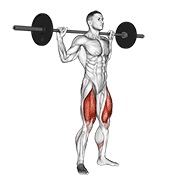
- Squat: the goblet squat or a barbell squat loads your legs and glutes.
- Push: the push-up or a dumbbell press trains your chest and shoulders.
- Pull: a row hits your back and the back of your arms.
- Hinge: a Romanian deadlift or hip hinge trains the back of your legs and lower back.
- Core: the front plank trains your trunk to stay stable under load.
The A/B full-body plan
Run two different sessions, Workout A and Workout B, and alternate them across your two training days with at least one rest day between. Warm up for five minutes first, then work through the list, resting one to two minutes between sets. If you have no equipment, the full-body bodyweight routine swaps neatly into either day.

| Day | Workout | Exercises | Sets x reps |
|---|---|---|---|
| Day 1 | A | Goblet squat, push-up, row | 3 x 8-12 each |
| Day 1 | A | Plank | 3 x 30-45 sec |
| Day 2 | B | Romanian deadlift, shoulder press, lunge | 3 x 8-12 each |
| Day 2 | B | Hanging or lying leg raise | 3 x 10-15 |
A sensible weekly shape is Workout A on Monday and Workout B on Thursday, but any two non-consecutive days work. Keep each session in the 40 to 50 minute range including the warm-up.
How to progress week to week
A two-day plan keeps producing results only if it gets harder over time, and the principle that drives this is progressive overload. Because you train each movement roughly once a week, the simplest progression is to beat last week's numbers by a small margin. Add one rep to a set, or add a little weight, or improve your control on the lowering phase. Change one thing at a time so you can see what is working.
- Weeks 1 to 2: learn the movements and settle on weights that let you finish every set with clean form.
- Weeks 3 to 4: add reps until you reach the top of each range on all sets.
- Weeks 5 to 6: increase the weight slightly and drop back to the bottom of the rep range, then climb again.
- Ongoing: repeat the cycle, and every six to eight weeks take a lighter week to recover.
Understanding sets and reps makes these choices second nature, and it keeps your two sessions punching above their weight.
Making the most of two sessions
With only two workouts to work with, every set counts, so protect their quality. Arrive reasonably rested, warm up properly, and keep your rest periods honest so you can push hard on each set. On your five off days, light activity such as walking supports recovery without adding fatigue, and it also burns extra calories if fat loss is a goal. Sleep and enough protein turn your effort into results, so treat recovery as part of the plan rather than an afterthought. Because the plan is compact, it is also easy to protect: two appointments a week are far simpler to keep than five.
Quality also means giving each exercise your full attention. When you only touch a movement once a week, a distracted, half-hearted set is a missed opportunity you will not get back for seven days. Put your phone away, focus on moving well, and treat the first working set of each exercise as the most important one, because it sets the tone for everything that follows. A useful habit is to arrive with a plan already written: know your target weights and reps before you start, so you spend your session executing rather than deciding. Over a few months, this discipline turns two modest sessions into steady, visible progress.
Common mistakes
- Treating the two days as separate random workouts. Rotate A and B deliberately so your whole body is covered twice.
- Going to failure on every set. Leave one or two reps in reserve so your form and recovery stay intact.
- Never adding load or reps. Without progression, two days a week will plateau. Beat last week by a little.
- Skipping the hinge or the pull. Missing a pattern builds imbalances. Cover all five jobs each week.
- Training the two days back to back. Leave at least one rest day between sessions.
Frequently asked questions (FAQ)
Can I really build muscle on just two days a week? Yes, especially as a beginner or a returning lifter. Two quality full-body sessions clear the weekly threshold most people need. As you advance, you can add a third day if your schedule allows.
What if I miss one of the two days? Do it as soon as you can, even on the weekend, rather than writing off the week. Consistency across months matters more than any single session landing on the perfect day.
Should I do cardio on top of this? Light walking on off days pairs well with a two-day plan and aids recovery and fat loss. Keep hard cardio modest so it does not eat into your lifting recovery.
Summary
Two well-designed full-body sessions a week are more than enough to get stronger and build muscle when you run them as a real plan. Rotate Workout A and Workout B, cover all five movement patterns, and beat last week's numbers by a small margin each time. Recover well on your off days and protect those two appointments. When you want a ready-made version, follow one of our busy 2-day programs. If any movement causes sharp pain, stop and consider checking with a professional.
Ready to put this into action? Start with a program for your level.
View programs →