Gym machines for beginners: which to use first
Walking into a gym full of machines can feel overwhelming. Rows of pulleys, pads, and pins, each with a small diagram you are not sure how to read - it is enough to make anyone want to retreat to the treadmill. The good news is that machines are one of the friendliest places for a beginner to start, and a handful of them cover almost every major muscle group. This guide explains why machines work so well early on, which ones to try first, how to set them up, and how to progress toward free weights when you are ready.
Why machines help beginners
Machines guide your body along a fixed path, so you do not have to balance the weight or worry about it tipping. That fixed path does three useful things. It keeps your form consistent rep after rep, it lets you focus on feeling the target muscle work instead of fighting to stay stable, and it makes the movement safer because there is far less chance of dropping a weight or losing control.
For someone still learning how each lift should feel, this stability is a real advantage. Machines also make it easy to adjust the load - just move a pin - so you can find the right weight quickly and apply progressive overload without fumbling with plates. None of this means machines are "easy mode"; it means they let you concentrate on the one thing that matters most early on: clean, controlled repetitions.
How to set up any machine
Before your first rep on any machine, take thirty seconds to set it up properly. Good setup is the difference between feeling the target muscle and straining a joint.
- Adjust the seat so the moving part lines up with the right joint (for a chest press, the handles should sit around chest height).
- Set the range so you feel a comfortable stretch without forcing your joints past their natural limit.
- Pick a light weight first and do a test set to check the path feels smooth and pain-free.
- Control the lowering phase, taking two to three seconds on the way back rather than letting the stack slam down.
If you are unsure, most gyms have staff who will happily walk you through a machine - and our form before weight guide explains why these details matter so much.
Machines to start with
A few machines and cable stations will take you a long way. Together they cover your back, chest, legs, and arms - a genuinely full-body routine.
| Machine | Main area | Try this |
|---|---|---|
| Lat pulldown | Back | Cable lat pulldown |
| Seated row | Mid-back | Cable seated row |
| Leg press | Legs | see upper legs |
| Chest press | Chest | see chest |
| Triceps pushdown | Arms | Cable triceps pushdown |
- Lat pulldown builds the back and is a great stepping stone toward pull-ups. Try the cable lat pulldown through a full range of motion, letting your shoulder blades move naturally.
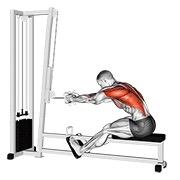
- Seated row trains the mid-back and improves posture - especially helpful if you spend the day at a desk. The cable seated row is a reliable staple.
- Leg press works the quads, hamstrings, and glutes with your back supported, making it a comfortable introduction to heavy leg training. Explore more in the upper legs category.
- Chest press develops pushing strength along a stable path, a good precursor to the bench press. See the chest category for related work.
- Triceps pushdown isolates the back of the arms simply and safely. The cable triceps pushdown with a V-bar is easy to learn, and the upper arms category has more options.
With these five movements you can build a balanced full-body session while you develop confidence and strength. For more on training the back specifically, browse the back category.
How to progress to free weights
Machines are a starting point, not a permanent destination. As your form and control improve, gradually introduce free-weight versions of the same patterns. A chest press machine prepares you for the bench press; the leg press builds a base for the barbell full squat; and the seated row translates directly to the dumbbell bent over row. Free weights ask more of your stabilising muscles and balance, which is exactly why they become valuable once you are ready.
A simple approach is to keep one or two machine exercises in your routine while adding a free-weight lift you are learning. Practise the new movement with light weight first - even just the bar or a pair of light dumbbells - then increase the load only when your technique is solid. There is no rush, and there is no rule that you must abandon machines entirely. Many experienced lifters use both for years.
A sensible first plan
Start with the five machines above, two or three sessions a week, and focus on smooth, controlled repetitions. Aim for two to three sets of around eight to twelve reps on each, resting a minute or two between sets. Keep a simple log of the weight and reps so you can gradually do a little more over time.
Once those movements feel easy and your form is consistent, begin folding in free-weight lifts one at a time. If you want a structured place to begin, our beginner guide covers the fundamentals, and a ready-made routine from the programs page - especially the beginner program - removes the guesswork entirely.
Common mistakes to avoid
- Using a weight that's too heavy and jerking the stack instead of controlling it. Lighter and smoother always beats heavier and sloppy.
- Skipping the seat adjustment. A machine set for someone else's body will load your joints in the wrong place.
- Going too fast. Rushing the lowering phase throws away half the benefit of each rep.
- Only doing machines you like. Cover back, chest, legs, and arms so your body develops evenly.
- Never progressing the weight. Machines make adding load easy - use that to apply progressive overload.
Frequently asked questions (FAQ)
Are machines as good as free weights? For building strength and muscle as a beginner, machines are excellent and very safe. Free weights add balance and coordination demands, so the best long-term plan usually includes both. Start with machines, then layer free weights in over time.
How long should I stick with machines before moving on? There is no fixed timeline. When your form is consistent and the weights feel controlled - often after several weeks - start adding one free-weight lift at a time while keeping some machine work.
How many machines do I need in one session? Around four to five well-chosen machines can cover your whole body. You do not need to use every machine in the gym; a focused, repeatable routine beats a random tour of equipment.
Summary
Machines are one of the best on-ramps to training. They keep your form consistent, let you focus on the target muscle, and make load adjustments simple - all while reducing the risk of losing control. Start with the lat pulldown, seated row, leg press, chest press, and triceps pushdown, set each one up carefully, and train two or three times a week with smooth, controlled reps.
As your confidence grows, fold in free-weight lifts one at a time and keep applying gradual progression. Ready to begin? Use our beginner guide to learn the fundamentals, pick the beginner program from the programs page, and pair this with our article on which muscles to train first. Take it step by step, and the gym floor will quickly start to feel like familiar territory.
Ready to put this into action? Start with a program for your level.
View programs →