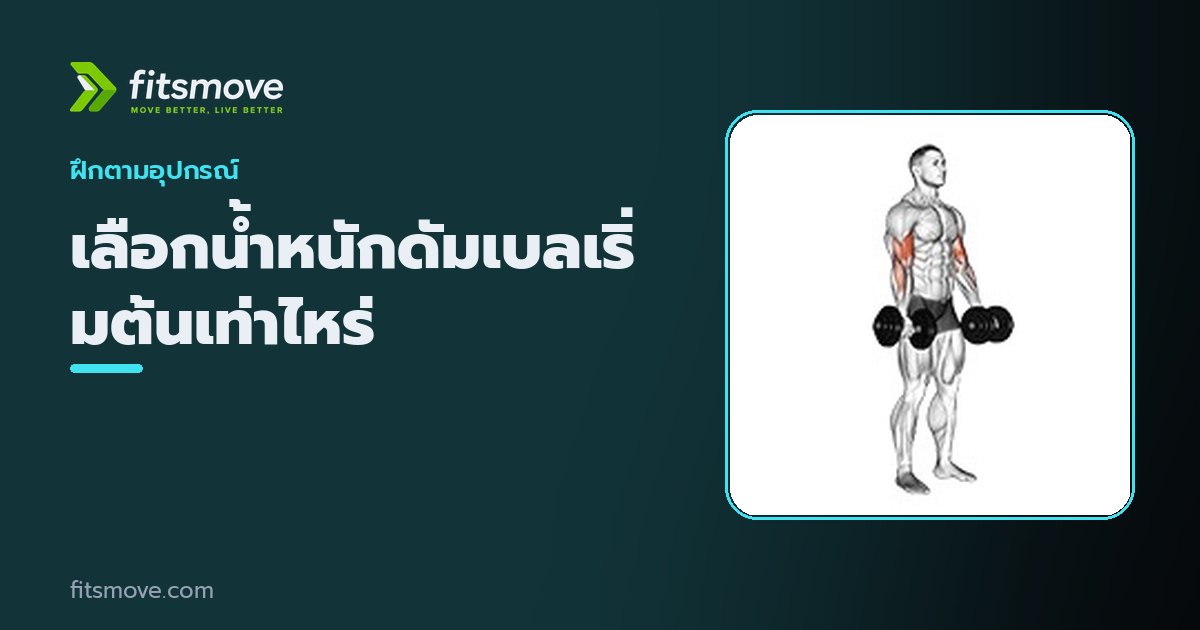
What dumbbell weight should you start with?
One of the first questions every new lifter asks is also one of the trickiest: how heavy should my dumbbells be? Go too light and the work feels pointless; go too heavy and your form collapses and you risk getting hurt. The honest answer is that there is no single right number, because the correct weight depends on the exercise, the muscle group, and you. This FitsMove guide gives you a practical way to judge your starting weight, a table of sensible starting points by muscle group, clear signs that it is time to go heavier, and the mistakes that trip people up.
Why there is no single answer
A dumbbell that feels perfect for a biceps curl will be far too light for a squat, and far too heavy for a lateral raise. Larger muscles like your legs, chest, and back can handle much more load than small muscles like your shoulders in a side raise. So instead of looking for one magic weight, you are really looking for the right weight for each movement.
This is why a single fixed pair of dumbbells is limiting, and why adjustable dumbbells or a small range of fixed pairs is so useful at home. Our budget home gym guide covers how to set this up affordably.
The repetition test
The simplest way to judge any weight is to use reps as your guide. Pick a weight, do a set, and notice how it feels. As a beginner aiming to build strength and muscle, you want a weight where the last two or three reps of a set are genuinely hard but your form stays clean.
- If you can do far more reps than planned with energy to spare, the weight is too light.
- If you cannot reach the bottom of your rep range, or your form breaks down, it is too heavy.
- If the final reps are challenging but controlled, the weight is right.
For most beginners, a target of around eight to twelve reps works well. If you reach twelve clean reps and could keep going, it is time to consider a heavier pair. This rep-based approach matters far more than any chart, because it responds to your real strength on the day.
Judging the weight by exercise type
Different exercise patterns demand different loads. A useful habit is to group exercises by how much weight they can handle.
| Exercise type | Examples | Relative load |
|---|---|---|
| Big lower-body | Goblet squat, lunge | Heaviest |
| Big upper-body push or pull | Press, row, chest press | Moderate to heavy |
| Single-joint arm work | Biceps curl, triceps extension | Lighter |
| Small shoulder work | Lateral raise, rear fly | Lightest |
A practical example: you might goblet squat with a weight that you could never use for a seated shoulder press, and that shoulder press weight would feel heavy for a lateral raise. Expecting the same dumbbell to serve all of these is the most common beginner misunderstanding.
A starting guide by muscle group
The numbers below are starting suggestions for a typical beginner, not rules. Treat them as a place to begin, then let the repetition test fine-tune from there. Weights are per dumbbell.
| Muscle group | Example move | Beginner start (women) | Beginner start (men) |
|---|---|---|---|
| Legs | Goblet squat | 6 to 10 kg | 10 to 16 kg |
| Chest | Dumbbell chest press | 4 to 8 kg | 8 to 12 kg |
| Back | Bent-over row | 5 to 8 kg | 8 to 14 kg |
| Shoulders (press) | Seated shoulder press | 3 to 6 kg | 6 to 10 kg |
| Shoulders (raise) | Lateral raise | 1 to 3 kg | 3 to 6 kg |
| Arms | Biceps curl | 3 to 6 kg | 6 to 10 kg |
These ranges are deliberately wide because people differ. The point is the pattern: legs heaviest, big pushes and pulls in the middle, and small shoulder work lightest. If you are torn between two weights, start with the lighter one and earn the heavier one. For a full session built around these lifts, see our full body dumbbell routine.
When to add weight
Adding weight over time is the heart of progress, a principle called progressive overload. But adding too soon ruins your form, and adding too late stalls your results. The clearest signal is simple: when you can complete all your planned sets and reps with good form, and the last reps no longer feel hard, it is time to go up.
A sensible step is the smallest jump available, often one to two kilograms per dumbbell. When you increase the weight, expect to do slightly fewer reps at first; that is normal and exactly the point. Work back up to your target rep range over a few sessions, then increase again. Keeping a short log of weight and reps makes this almost automatic, and it removes the guesswork about whether you are actually progressing.
Common mistakes to avoid
- Buying one fixed pair and using it for everything. No single weight suits squats and lateral raises. Get a range or adjustable dumbbells.
- Choosing weight by ego. A weight you can only swing with sloppy form is not building anything useful. Control first.
- Going too light forever. If the last reps never feel hard, the muscle has no reason to change. Push the difficulty.
- Jumping up too fast. Big weight increases wreck your form. Use the smallest available step.
- Not tracking anything. Without a log you cannot tell if you are progressing, so you drift.
Frequently asked questions (FAQ)
What if I can only afford one pair of dumbbells? Choose a weight that challenges your medium-sized muscles, such as a chest press or row, then use higher reps for legs and slower, stricter form for small shoulder work. Adjustable dumbbells solve this best if your budget allows, and our budget home gym guide has options.
Should men and women start at different weights? On average, starting weights differ, which is why the table shows ranges. But the principle is identical for everyone: pick a weight where the last few reps are hard with good form, and progress from there. Judge by feel, not by the label on the rack.
How often should I increase the weight? Whenever the current weight becomes easy for all your sets, which for a beginner can be every week or two early on, then more slowly over time. There is no fixed schedule; let your performance decide.
Summary
There is no universal starting weight, only the right weight for each exercise and for you on the day. Use the repetition test as your master tool: aim for a load where the final reps of a set are hard but your form holds. Expect legs to take the most weight, big pushes and pulls to sit in the middle, and small shoulder work to be lightest, and use the starting table as a launch point rather than a rule.
When all your reps become easy with clean form, add the smallest step of weight and keep applying progressive overload. To put this into action, follow our full body dumbbell routine and pick a structured plan from the programs page. Start a little lighter than you think, earn each increase, and you will build strength steadily and safely.
Ready to put this into action? Start with a program for your level.
View programs →